The Call Center’s Main Purpose is to Retain Customers

Download this PDF

The call center’s main purpose is to retain customers in order to maximize and protect the organization’s greatest asset - its customers. In other words, it is the call center’s responsibility to retain customers so they do not defect to the organization’s competition as a result of their call center experience, rather than the call center creating customer loyalty for the organization

Written By, Mike Desmarais, President and Founder
of SQM Group
     

Introduction


If you ask call center professionals what their call center’s main purpose is, you hear answers such as to service customers, to resolve their calls, to operate in an effective and efficient manner, to service and sell to customers, to create customer loyalty to the organization and to help bring in new customers to the organization. These are all good purposes however, it is SQM’s belief that the call center’s main purpose is to retain customers in order to maximize and protect the organization’s greatest asset - its customers. In other words, it is the call center’s responsibility to retain customers so they do not defect to the organization’s competition as a result of their call center experience, rather than the call center creating customer loyalty for the organization.

SQM believes the main purpose is to retain customers because customer loyalty cannot be created by a customer who typically calls into the organization 1 to 2 times a year, has a 4 to 6 minute phone conversation and the call is resolved. It is SQM’s experience that within a short period of time, the customer forgets they called the call center. The above scenario represents between 65% and 85% of all customers who call the call center. However, it is important to mention that the call center has done its job to help retain these customers for the organization. Again, with a customer who typically has a 4 to 6 minute call it is very difficult to create customer loyalty to the point that a customer will go out of their way to actually buy more products and services or recommend the organization to others. The exception to this behavior would be add-on sales while you have the customer on the phone. In most of these cases, the call was resolved which, in turn, gave the CSR the right to make a selling offer to the customer. So the same logic should apply to the call center in that if the call center does a good job at retaining customers it has therefore earned the right to sell. If the call center does not do a good job at retaining customers it has not earned the right to make selling a key component of the call center purpose.

Between 15% and 35% of customers who call a call center have a 4 to 60 minute phone conversation and the call is unresolved. These customers will not forget that they called the call center. In fact, when the call is not resolved our research shows that they will tell, on average, 5 people about their experiences using the call center to try to resolve their inquiry or problem. Also, 15% of customers will not continue to do business with the organization as a result of their experience using the call center to try to resolve their inquiry or problem. Most of the calls that are not resolved tend to be more complex calls (e.g., technical, billing and complaints). Many call center professionals focus on trying to create more evangelistic customers, when the real focus should be on the 15% to 35% of customers who did not get their call resolved; of those customers, at least 15% will likely defect to another organization. Again, the focus needs to be on retaining your existing customers especially if 15% or more of your calls are unresolved or you have 5% or more of your customers who are dissatisfied with the overall call center experience.

Focusing on retaining customers is even more critical today than it was 5 years ago because of the increased complexity of the calls coming into the call center. Call centers are handling more complex calls than ever before because the IVR and web self-service channels are handling the simpler calls. As most call center professionals know, call centers have always handled complex calls; however, the frequency of complex calls has increased drastically. SQM’s call center benchmarking data showed that in 2002 the average call length was approximately 4 minutes and in 2007 the average call length (talk-time and wrap-up) was approximately 5.5 minutes. This is a 38% increase in call length, which is a legitimate proxy for measuring call complexity increase. SQM’s data also shows that IVR utilization in 2002 was 26% of all inbound call volume and in 2007 IVR utilization is at 68% of all inbound call volume. So in the last 5 years, IVR utilization has almost tripled. Also, call types handled by the IVR, which are the same as what a CSR would handle, are at 56% and increasing every year. As most people know the web contact channel has also increased drastically in the last 5 years.

The support structure to handle calls in the last 5 years has not changed in accordance with the increasing complexity of call types. For example, when a customer calls in a second or third time trying to resolve their call, in most cases, they have to repeat their messages to different CSRs for every call. This is the same practice that has taken place for the past 5 years. Order taking, sales and account inquiries tend to be less complex calls and technical, billing and complaints tend to be more complex calls.

Because calls are becoming more complex and resolving those complex customer calls is so critical to retaining customers, we have written this article to help call center professionals improve their call resolution performance for handling complex calls. In an effort to better understand call centers’ impact on retaining customers we have used SQM’s call center 2007 benchmarking data. The study sample includes over 300 leading call centers, 400,000 customers who recently called a call center and over 22,000 employees who work in a call center. The results of SQM’s call center benchmarking study provide insightful information on call centers’ impact on retaining customers for the following seven key industries: retail, health care, energy, insurance, financial, government and telecommunication. SQM’s call center benchmarking study examines the areas that are most important for helping call centers retain customers. Specifically, SQM’s study examines call center performance by industry and by aggregate to determine:

  • What is most important to customers calling a call center
  • Call resolution impact on call center customer loyalty impact indicators
  • Unresolved calls financial impact on operating cost
  • Areas for improving why customers have to call 2 or more times
  • Impact on customer satisfaction (Csat) and first call resolution (FCR) when calls are transferred to escalation CSRs
  • Resources CSRs use to resolve calls and their satisfaction with those resources
  • Call centers and their organization’s Csat
  • Contact channel comparison for Csat and FCR performance
  • Outsourcer comparison for Csat and FCR performance

FCR and Call Resolution Impact on Call Centers & Organizations


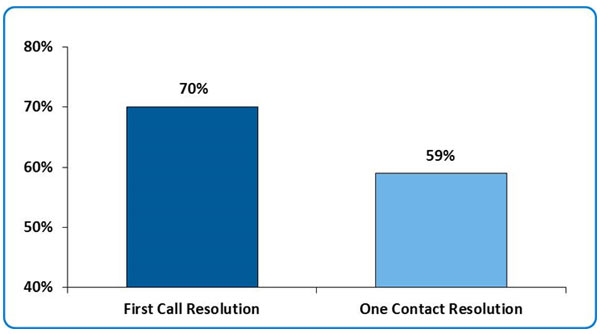
It is SQM’s strong opinion that FCR and call resolution are the most important metrics for determining if the call center experience is both satisfying and helping to retain customers. SQM’s definition of FCR is the… “Customer’s inquiry or problem is resolved in one call.” Furthermore the customer, not call center management, must be the judge of FCR. We are often asked what the difference is between FCR and call resolution. The main difference is that for call resolution to occur it might take more than 1 call whereas FCR only takes one call. SQM believes having the customer be the judge of FCR is the best practice. As shown in Figure 1, call resolution is the most important metric for customers calling a call center. CSR metrics such as knowledge, helpfulness, caring and listening are also very important metrics for customers. Customer navigation and speed metrics such as wait time, customer identification and voice menu have lower importance for customers. Selling metrics such as features, needs based selling and selling approach also have low importance for customers. Navigation and selling metrics tend to be areas that call center managers focus their efforts on versus call resolution, which is the most important metric for customers.

Figure 1: The Most Important Metrics to Customers Calling a Call Center

The Most Important Metrics to Customers Calling a Call Center

Key Finding: Call resolution is the most important metric for customers calling a call center. Figure 1 numbers are based on a statistical correlation between call center overall Csat and each specific metric’s Csat.

Call Resolution Impact on Call Center Customer Loyalty Impact Indicators


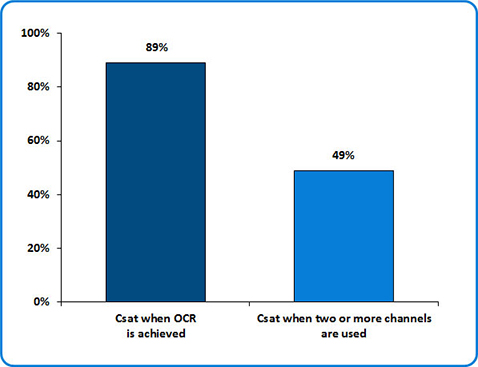
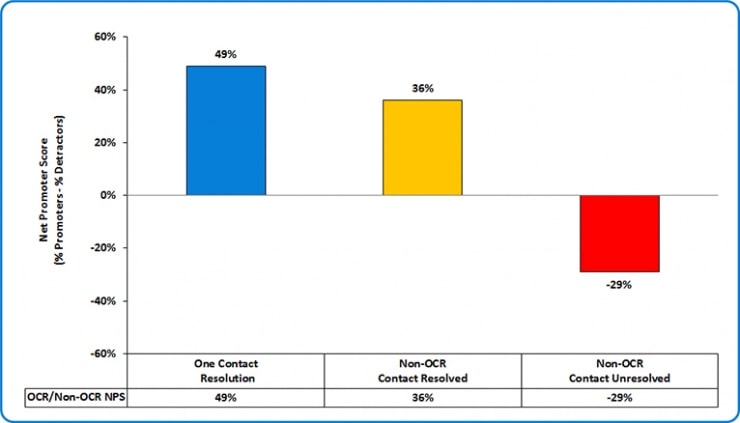
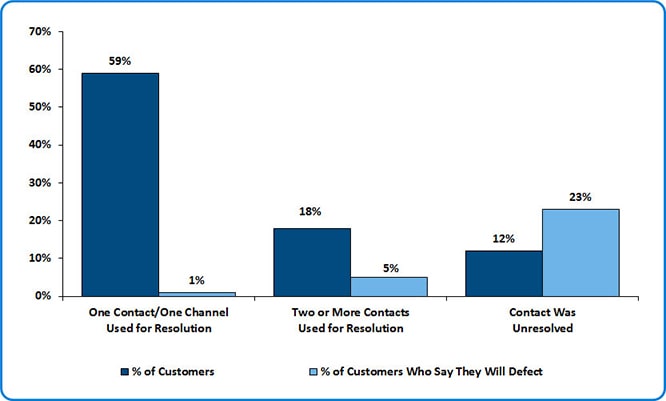
Figure 2 shows that customers who did not get their call resolved have a huge negative impact on call center customer loyalty impact indicators such as call center overall Csat, likelihood of continuing to do business and likelihood to recommend the organization to others. In fact, customers who did not get their call resolved are 5 times more likely to defect than customers whose call was resolved. Customers whose call was resolved have a substantially higher call center overall Csat and are more likely to continue to do business with the organization. Also, call resolution has a higher impact on a customer’s willingness to continue to do business with the organization than their willingness to recommend the organization to others. The bottom line is that call resolution has a bigger impact on call center Csat and continue to do business, than to recommend to others. This underscores the fact that call centers’ main purpose should be to retain customers. It is very clear from SQM’s research that when a call is resolved, the customer, in most cases, is satisfied and the call center did its job in retaining the customer for the organization. It is also very clear from SQM’s research that when the call is resolved on the first call the customer is very satisfied and the call center benefits from not having to take 2 or more calls to resolve the call.

Figure 2: Call Resolution Impact on Call Center Customer Loyalty Impact Indicators

Call Resolution Impact on Call Center Customer Loyalty Impact Indicators

Key Finding: Customers that did not get their call resolved have a huge negative impact on the above call center customer loyalty impact indicators.

FCR and Call Resolution Differences by Industry


As shown in Figure 3, SQM’s benchmark studies show that there are significant FCR performance differences by industry. FCR ranking by industry is similar to the call resolution ranking by industry. There are only moderate call resolution differences by industry. It is SQM’s experience that the telco/TV industry is the most complex industry with the insurance, financial and banking industries being almost as complex. What is most interesting is that the insurance, financial and banking industries perform better than the telco/TV industry. The key message here is that complex industries can achieve high FCR and call resolution performance.

Figure 3: FCR and Call Resolution Differences by Industry

FCR and Call Resolution Differences by Industry

Key Finding: There are significant FCR performance differences by industry and moderate call resolution differences by industry.

Unresolved Calls Impact on Operating Cost


Figure 4 shows that for the average call center only 49.76% of inbound calls are “one and done”. That means approximately 50% of inbound calls are the result of the customer’s call not being resolved on the first call. The average call center resolves 68% of their calls on the first call. This means that up to 32% of customers have to call back because their issue is not resolved the first time. However, SQM’s research shows that 30% of customers who did not get their call resolved will not call back. Call-backs account for a large amount of a call center’s annual budget. In fact, two-plus calls account for 15% of the average annual budget. It is important to note that the call center industry average to resolve a customer’s inquiry or problem is 1.4 calls. This represents, in most cases, the biggest area for call centers to reduce their operating costs. The number of additional calls made to the average call center that SQM benchmarks, is approximately 1,001,122 which represents 29% of the total call volume. In most cases, world class call centers have between 10% and 15% additional calls as a result of not achieving FCR.

Figure 4: Unresolved Calls Impact on Operating Cost

Unresolved Calls Impact on Operating Cost

Note: For the average call center only 49.76% of inbound calls are “one and done”. That means approximately 50% of inbound calls are the result of the customer’s call not being resolved on the first call.

Impact on Csat and FCR when Calls are Transferred to Escalation CSRs


Figure 5 shows that customer Csat decreases by 20% and FCR decreases by 19% when calls are transferred to escalation CSRs. There are 9 main reasons why overall customer Csat and FCR performance for escalated calls is 20% lower than for non-escalated calls.

  • Most escalated calls are more complex than normal calls.
  • Many call center CSRs are discouraged from transferring their call to the escalation queue and are punished if they do it too often.
  • Most call centers do not properly staff their escalation queues to handle customer escalated calls and they view escalated calls as an unnecessary extra cost.
  • The vast majority of call centers make it difficult for customers to transfer their call to CSRs who handle escalation calls by not informing customers it is an option or by making customers go through a long question and answer session.
  • The majority of escalation CSRs can handle complex calls; they tend not to be as good at service recovery. In other words, they can fix the problem, but they lack the required people skills to deal with dissatisfied or upset customers.
  • When calls are transferred to the escalation queue the customer has to repeat the details of their issue because they do not experience warm transfers.
  • Customers are put on hold for a long time before they can talk to an escalation CSR.
  • Most call centers do not measure Csat or FCR for the escalation queue.
  • The call center does not have dedicated CSRs to handle escalated calls; therefore, the original CSR has to find someone who can help the customer.

It is SQM’s belief that the call escalation queue is the key to retaining customers for the organization. However, most call center managers do not utilize the escalation queue for retaining customers. Call escalation queues tend to be small and are not very effective in managing the customer’s experience.

Figure 5: Impact on Csat and FCR when Calls are Transferred to Escalation CSRs

Impact on Csat and FCR when Calls are Transferred to Escalation CSRs

Key Finding: Customer Csat decreases by 20% and FCR decreases by 19% when calls are transferred to an escalation CSR.

Resources CSRs Use to Resolve Calls and Their Satisfaction with Those Resources


Figure 6 shows when front-line CSRs need help in resolving calls they ask another CSR and in most cases, they ask the CSR sitting closest to them. Another resource frequently used is on-line manuals. What is most interesting about this is that subject matter CSRs and escalation CSRs are not used very often to help CSRs resolve calls.

Figure 6: Resources CSRs Use to Resolve Calls

Resources CSRs Use to Resolve Calls

Key Finding: Subject matter CSRs and escalation CSRs are not used very frequently to resolve calls.

Figure 7 shows CSR satisfaction with the availability of real-time support (e.g., peer, supervisor, on-line manual and escalation queue) for resolving difficult customer calls. Only 9% of CSRs are very satisfied with the real-time support for helping them resolve customer calls. The real-time support attribute has one of the lowest satisfaction levels of all the attributes that SQM measures for CSR satisfaction.

Figure 7: CSRs Satisfaction with Real-time Support for Resolving Calls

CSRs Satisfaction with Real-time Support for Resolving Calls

Key Finding: Only 9% of CSRs are very satisfied with the real-time support for helping them resolve customer calls.

Csat with Call Centers & Their Organizations


As shown in Figure 8, there are large Csat rating differences by industry for both the call center and organization. However, the call center Csat ranking and the organization Csat ranking are the same. Csat ratings are based on top box customer satisfaction ratings. It is SQM’s experience that an organization’s ability to satisfy customers does impact the call center’s ability to satisfy customers. SQM’s data also shows that, in many cases, when the organization’s satisfaction rating goes up so does the call center’s and when the organization’s satisfaction rating goes down so does the call center’s. This is particularly true when the organization experiences billing problems or improves billing practices. If the call center does not resolve the customer’s call it has a negative impact on the organization’s overall Csat ratings. Again, the reasons for this are that most unresolved calls are between 4 to 60 minutes in length and most customers remember their unresolved call experience. However, when a customer’s call is resolved there is not necessarily a positive impact on the organization’s overall satisfaction ratings. Again, the reasons for this are that most resolved calls are between 4 to 6 minutes in length and the customer expects the CSR to resolve their call. Also, in a short period of time most customers forget that they even called the call center. The retail industry had the highest Csat for call centers at 78% and also the highest Csat ratings for an organization at 73%. The telco/TV industry had the lowest Csat for call centers at 57% and also the lowest Csat ratings for an organization at 43%. Industries with higher organization Csat ratings (retail, financial and insurance) have higher call center Csat ratings. Conversely, industries with lower organization Csat ratings (government and telco/TV) have lower call center Csat ratings.

Figure 8: Csat with Call Centers & Their Organizations

Csat with Call Centers and Their Organizations

Key Finding: There are large Csat rating differences by industry for both the call center and organization Csat ratings. In addition, the call center Csat ranking and the organization Csat ranking are the same.

Contact Channel Comparison for Csat and FCR Performance


As shown in Figure 9, web and IVR self-service contact channels have the highest Csat and FCR ratings of all contact channels. It is SQM’s experience that these contact channels also have the easiest contact types to resolve. It is also SQM’s experience that CSR and email contact channels have the most complex contacts to resolve and that is the main reason why Csat and FCR is lower in these contact channels. SQM’s research also shows that 14% of call center customers start with using the web channel. SQM’s research shows that the vast majority of customers that use web and IVR self-service channels to complete their transaction are successful in using those contact channels to process their transaction.

Figure 9: Contact Channel Comparison for Csat and FCR Performance

Contact Channel Comparison for Csat and FCR Performance

Key Finding: Web and IVR self-service contact channels have the highest Csat and FCR ratings of all contact channels.

Outsourcer Comparison for Csat and FCR Performance


Figure 10 shows that the average for outsourcer performance is 8% lower for Csat and 4% lower for FCR than in-house call centers. The gap in outsourcer performance has drastically improved in the last 2 years with outsourcers making major improvements. In SQM’s benchmarking database we have outsourcers with higher Csat and FCR performance than in-house call centers, as well as outsourcers with significantly lower Csat and FCR performance. We have very few outsourcers whose performance is consistent with their client in-house call center’s performance. At SQM, the biggest change we see with outsourcers is that they are no longer being paid based on call volume only. Bonuses and contract renewals are based on their Csat and call resolution performance and we believe this is one of the main reasons why we see outsourcer performance improve.

Figure 10: Outsourcer Comparison for Csat and FCR Performance

Outsourcer Comparison for Csat and FCR Performance

Key Finding: The average for outsourcer performance is 8% lower for Csat and 4% lower for FCR than in-house call centers.

Summary and Conclusions


SQM believes that the call center’s main purpose is to retain customers in order to maximize and protect the organization’s greatest asset - its customers. In other words, it is the call center’s responsibility to retain customers so they do not defect to their competition as a result of their call center experience, rather than the call center creating customer loyalty for the organization.

It is SQM’s experience that an organization’s ability to satisfy customers does impact the call center’s ability to satisfy customers. SQM’s data also shows that in many cases when the organization’s satisfaction rating goes up so does the call center’s and when the organization’s satisfaction rating goes down so does the call center’s. This is particularly true when the organization improves their billing practices or experiences billing problems. If the call center does not resolve the customer’s call it has a negative impact on the organization’s overall Csat ratings. In fact, customers who did not get their call resolved are 5 times more likely to defect than customers whose call was resolved.

It is SQM’s strong opinion that FCR and call resolution are the most important metrics for determining if the call center is both satisfying and helping to retain customers. SQM’s definition of FCR is the… “Customer’s inquiry or problem is resolved in one call”. Furthermore, the customer, not call center management, must be the judge of FCR.

For the average call center only 49.76% of inbound calls are “one and done”. That means approximately 50% of inbound calls are the result of the customer’s call not being resolved on the first call.

It is very clear that an effective call escalation process can avoid many of the additional calls to resolve and at the same time improve Csat and retain the organization’s customers. SQM research clearly shows if call escalation is handled effectively customer satisfaction does not drop. However, there is a 15 point drop in Csat for each additional call required to resolve the customer’s call. It is SQM’s belief that the call escalation queue is the key to retaining customers for the organization. However, most call center managers do not utilize the escalation queue for customer retaining purposes. Call escalation queues tend to be small and are not very effective in managing the customer’s experience.

Also, total average handle time (AHT) is shorter with the original CSR and the escalation CSR versus 2 or more individual CSRs handling the call separately. Only 9% of CSRs are very satisfied with the real-time support for helping them resolve customer calls. The real-time support attribute has one of the lowest satisfaction levels of all the attributes that SQM measures for CSR satisfaction.

Fixing the reasons why customers have to call 2 or more times is one of the most valuable initiatives that call center management can do to improve their call center Csat, FCR performance and retain the organization’s customers.

Web and IVR self-service contact channels have the highest Csat and FCR ratings of all contact channels. It is SQM’s experience these contact channels are also the easiest contact types to resolve. It is also SQM’s experience that CSR and email contact channels are the most complex contact types to resolve and that is the main reason why Csat and FCR is lower in these contact channels. SQM’s research shows that the vast majority of customers that use web and IVR self-service channels to complete their transaction are successful in using those contact channels to process their transaction.

The average for outsourcer performance is 8% lower for Csat and 4% lower for FCR than their client’s in-house call centers. The gap in outsourcer performance has drastically improved in the last 2 years with outsourcers making major improvements. In SQM’s benchmarking database we have outsourcers with higher Csat and FCR performance than in-house call centers, as well as outsourcers that have significantly lower Csat and FCR performance. SQM’s benchmarking database shows very few outsourcers whose performance is consistent with their client’s in-house call center’s performance. At SQM, the biggest change we see with outsourcers is that they are no longer being paid for call volume only. Bonuses and contract renewals are based on their Csat and call resolution performance and we believe this is one of the main reasons why we see outsourcer performance improve.

About SQM Group


Since 1996, Service Quality Measurement (SQM) Group has been a call center industry leader for improving our clients’ operating cost, customer service and retention. We have done this by being operationally excellent at conducting repeat call analysis and benchmarking, tracking, consulting, awarding and certifying FCR, Esat and Csat performance. Over 70% of our tracking clients improve their FCR and operating cost year over year. For those clients that have improved they have experienced on average a 5% FCR improvement. For the average call center SQM benchmarks, a 1% improvement in their FCR performance equals $276,000 in annual operational savings. Some clients have improved their FCR performance by as much as 12% within 30 days of implementing SQM’s FCR best practices. Our research also shows that when you improve your FCR, not only do you achieve operational savings, you also reduce customers at risk which is typically a 5-10 times greater savings opportunity than the operational FCR improvement savings.

In the last 5 years, SQM has a revenue growth of over 400%, a sky-high client retention rate of 95% and has been recognized by Profit 100 magazine as one of the fastest growing companies in Canada. Profit 100 magazine published a case study on how SQM was able to achieve over 400% revenue growth and a 95% client retention rate. Please see SQM’s press release regarding the PROFIT 100 recognition and our client’s feedback about the recognition.

SQM benchmarks over 400 leading international call centers on an annual basis and has been conducting FCR Csat benchmarking studies since 1996. On an annual basis, SQM conducts over 1 million surveys (over 450,000 live surveys and over 550,000 IVR surveys) with customers who have used a call center, email, website or IVR contact channel service. SQM also conducts over 25,000 surveys yearly with employees who work in call centers. Our customer and employee survey database is one of the largest in North America. SQM does business in 11 countries around the globe: Canada, United States, Argentina, Australia, Puerto Rico, India, Philippines, Costa Rica, Mexico, Dominican Republic and Jamaica.

SQM awards excellence in service quality for the call center industry. Our awards are based on customers who have used a call center and employees who work in a call center and are considered to be the fairest and most prestigious call center awards in the call center industry. We have recognized top performing call centers for Csat and Esat since 1998. SQM evaluates over 400 leading international call centers each year such as Marriott, Sears, Canadian Tire, US Bank, Wells Fargo, Rogers, Capital One, CitiFinancial, Scotiabank, Discovercard, Blue Cross, etc.

Our post-call surveying methodology continues to be leading edge. SQM conducts live surveys through our own dedicated workforce or use our in-house IVR, web and email survey technology. All post-call survey methods can be integrated into one common database. We can also survey within 5 minutes of the customer’s call without having to rely on a transfer into our technology. Our call list management system allows us to accurately deliver a survey quota at a customer representative level or any other survey quota level that is required. To ensure the quality of our survey data and feedback collection, SQM monitors 100% of our survey calls. The accuracy of each telephone survey representative is individually tracked and must comply with our minimum error rate of less than 1%.

Our Customer Quality Assurance evaluation is a unique service where, for the same call, SQM conducts a telephone customer satisfaction (live or IVR) survey and combines the survey data with call compliance evaluation data using SQM’s data capturing technology for integrating the two data sources. Call compliance evaluations are conducted by using your call recording system and using SQM’s call quality evaluators, your in-house QA evaluators or a combination.

Our reporting is available in real-time via our secure website. Customer representatives and supervisors have direct and secure access to their reports and coaching logs. Analysts have full access to over 60 FCR Csat pre-formatted and easily exported reports with full ability to sort and search the data for ad-hoc reporting. In addition, our reporting capabilities allows the integration of Csat survey and call quality assurance evaluation data.

Our experience in FCR, Csat, CQA and Esat measuring, benchmarking, tracking, evaluating and helping call centers improve are unsurpassed and enable us to provide call centers with best practices. These best practices help our clients reduce their operating cost, improve their customer satisfaction, reduce their customers at risk and increase their opportunities to sell to customers. The bottom line is that our secret ingredient is our clients’ success.