
The Voice of the Customer (VoC) has become one of the most powerful tools in the modern contact center. Customers share exactly what worked, what didn’t, and what they expected instead. But while most organizations collect feedback, far fewer use it in a way that creates meaningful change.
That gap is exactly where the competitive advantage exists.
Companies that win aren’t the ones gathering the most data—they’re the ones using customer feedback to improve agent performance, strengthen processes, and elevate the overall experience. At SQM Group, we see this daily through our Customer Quality Assurance (CQA) approach, which connects QA, CSAT, and FCR to show how customer perception aligns with actual performance results.
When you combine how the customer felt, what the agent did, and whether the issue was resolved, VoC becomes far more than a survey—it becomes a practical roadmap for improvement.
This blog explores what VoC really reveals, how CQA turns it into action, and how organizations use it to gain a measurable competitive advantage.
1. What Does the Voice of the Customer Really Tell You?
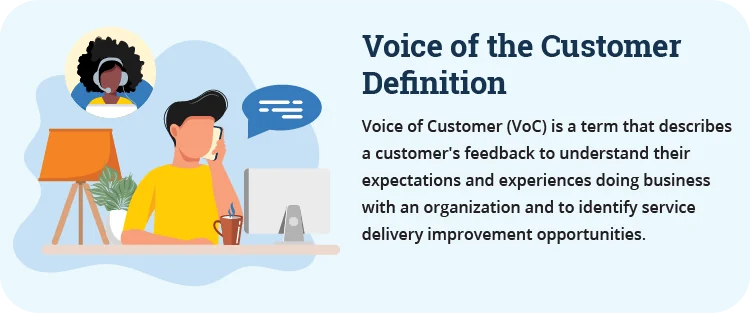
The Voice of the Customer goes far deeper than a simple “satisfied” or “not satisfied” answer. Each piece of feedback, especially open-ended comments, reveals how customers experience your service on a personal level. Customers describe what they appreciated, what frustrated them, and what they expected to happen during the call. These insights help contact centers understand not only what occurred during the interaction but how the interaction made the customer feel. This emotional insight is often the difference between loyalty and disengagement.
VoC also highlights patterns you can’t see through QA alone. When multiple customers mention the same issue, it often signals a larger issue that may be tied to policy, system design, or outdated processes. These trends can guide leaders to the improvements with the greatest impact on both CSAT and operational efficiency.
Instead of viewing VoC as isolated survey answers, organizations should see VoC as a detailed narrative directly from the customer. It reveals the real story behind the experience and acts as a guide for where to focus improvements.
Moving beyond satisfaction scores
A customer gives a low CSAT score with the comment:
“I had to call three different times.”
This tells you the root cause isn’t soft skills or tone—it’s a First Call Resolution (FCR) issue.
VoC doesn’t just measure satisfaction; it reveals what matters most to customers and why.
2. Why Most Contact Centers Struggle to Use VoC Effectively
Even though contact centers gather thousands of surveys, many teams struggle to translate those insights into day-to-day improvements. Feedback often sits in a dashboard or spreadsheet that leaders don’t have time to analyze deeply. As a result, valuable insights go unused, and agents continue facing the same challenges that customers repeatedly highlight.
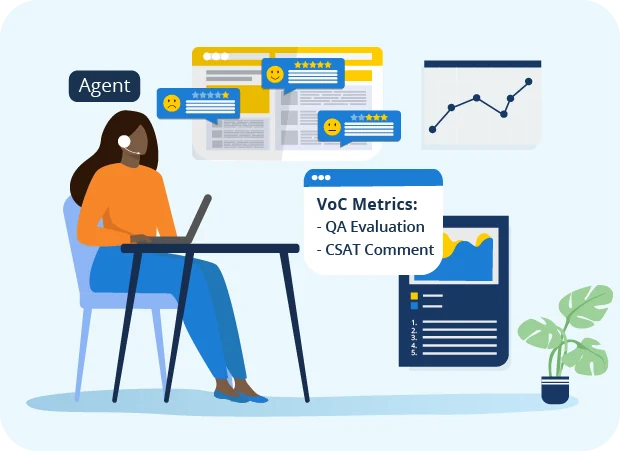
Another challenge is fragmentation—VoC data is often disconnected from QA evaluations, coaching notes, and operational data. When insights aren’t tied together, it’s impossible to see cause and effect. Supervisors may focus coaching on tone or compliance without realizing customers were actually frustrated with repeated calls or unclear policies.
This leads to the insight gap: organizations have the information but can’t use it effectively.
The insight gap
QA evaluation: “Agent followed all procedures.”
CSAT comment: “I left the call still confused.”
Without connecting these two data points, the coaching opportunity is unclear and ineffective.
VoC alone isn’t enough—it must be tied to behavior and outcomes to help supervisors make meaningful improvements.
3. How SQM’s Customer Quality Assurance (CQA) Turns VoC Into Action
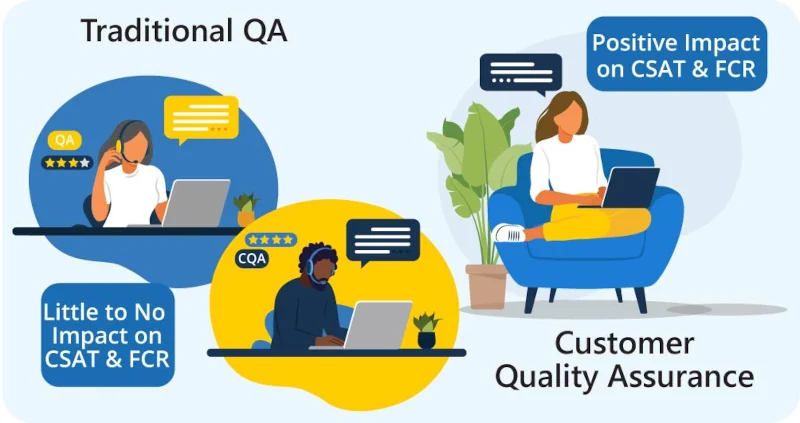
Traditional QA focuses on what the agent did: procedures, tone, accuracy, compliance. VoC focuses on how the customer felt: confident, confused, frustrated, or relieved. SQM’s CQA brings these two sides together, giving organizations a complete picture of service quality—not just one perspective.
By linking QA, CSAT, and FCR for the same interaction, CQA helps leaders understand which behaviors actually drive positive customer experiences. It also highlights when internal performance measures don’t match customer expectations. This level of insight allows coaches to focus on the behaviors that genuinely move the needle on satisfaction, resolution, and loyalty.
CQA reveals gaps that traditional QA can’t see:
- QA: “Agent followed every step.”
- CSAT: “The call was confusing.”
- FCR: “Customer had to call back.”
That gap is the opportunity.
Agents who consistently improve one common VoC theme—such as clearly summarizing next steps—see measurable improvements in CSAT and FCR.
CQA turns raw feedback into a clear, repeatable improvement strategy.
4. How VoC Drives Better Coaching and Agent Development
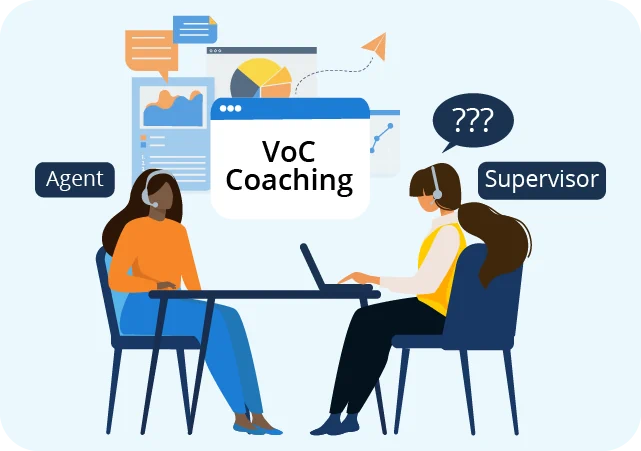
Agents want coaching that is clear, fair, and based on real examples—not guesswork. That’s what makes VoC so effective. It gives agents direct insight into how their communication, tone, and problem-solving impacted the customer.
VoC also helps supervisors pinpoint patterns across calls. Instead of speculating why a CSAT score dropped, coaches can reference the customer’s own words. This makes coaching more objective and improves acceptance and buy-in.
VoC reveals:
- What customers appreciated
- What caused confusion
- Which behaviors build trust
- Which behaviors lead to repeat calls
- Which patterns are emerging across multiple interactions
VoC adds another layer of clarity by helping agents understand why customers felt the way they did. VoC also reveals the specific moments within a call that shaped the customer’s experience. When agents can see the exact words, customers use to describe clarity, confusion, or trust, it becomes much easier to connect behavior to outcome.
Example:
Positive trend: “The agent explained everything clearly.”
Leaders can highlight exactly what “clear” looked like in that interaction.
Negative trend: “I didn’t understand what the agent said.”
Signals the need for better pacing, tone, or verification.
Because this feedback comes directly from customers—not the supervisor—it feels fair, credible, and actionable.
5. Turning VoC Insights Into Operational Improvements
VoC isn’t only about evaluating agent performance—it uncovers deeper issues in processes, systems, and policies that customers struggle with. When the same complaint appears across dozens of surveys, it’s a clear sign that the problem lives in the workflow, not just the conversation. VoC helps leaders pinpoint which changes will remove friction for the largest number of customers.
Examples of VoC-driven operational improvements:
- Simplifying verification steps when customers complain about repeating information
- Reducing AHT if customers report feeling rushed
- Updating knowledge base articles when explanations are unclear
- Improving self-service when customers express frustration completing tasks online
- Fixing broken workflows when multiple customers hit the same roadblock.

VoC makes these issues unmistakable. Instead of guessing where the process breaks down, leaders can see exactly which steps caused frustration—and how often customers are experiencing the same pain point. This turns feedback into a roadmap for repairing root causes, not just improving individual calls.
Fixing the process, not just the conversation
Dozens of customers say:
“I had to repeat my information multiple times.”
Improving this fixes:
- Customer satisfaction (CSAT)
- Handle time
- First Call Resolution (FCR)
- Agent morale
When processes improve, frontline service immediately improves with them. VoC guides leaders to the changes that have the biggest impact for the most customers—creating faster, clearer, and more consistent experiences.
6. Measuring the Business Impact of VoC
VoC directly influences bottom-line business results. Each insight, when acted on, leads to better experiences, fewer repeat calls, and stronger customer loyalty. This is where VoC truly becomes a competitive advantage.
When feedback is used well, organizations see:
- Higher FCR (fewer repeat calls, lower costs)
- Higher CSAT (better experiences, stronger loyalty)
- Better agent performance (clearer expectations, targeted coaching)
- Lower churn (customers stay longer when problems are resolved)
- Stronger retention (one of the biggest ROI drivers)
SQM research shows:
Customers whose issues are resolved on the first call are far more likely to remain loyal, continue spending, and recommend the organization.
VoC software helps leaders understand exactly what drives that loyalty.

7. How mySQM™ Makes VoC Easy to Use (Not Just Collect)
Collecting feedback is easy. Using it effectively is hard.
mySQM™ closes that gap.
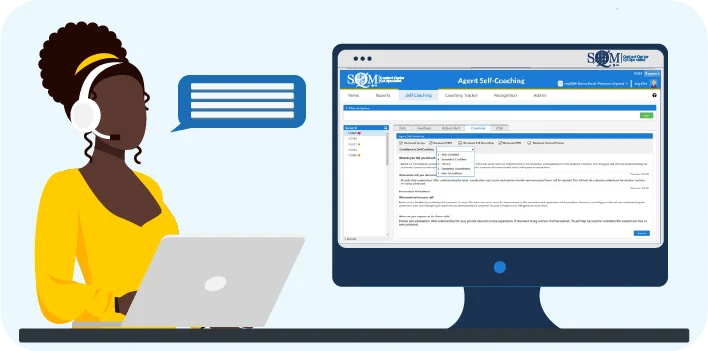
By combining QA, CSAT, FCR, and customer comments in one platform, mySQM™ gives supervisors and agents real-time insights they can use immediately—without digging through multiple systems.
The platform also supports continuous development through:
- Agent self-coaching tools
- Personalized development plans
- Real-time alerts
- Trend identification
- Dashboards built for clarity
Real-time example:
An agent receives an alert:
“The explanation wasn’t clear.”
They review the call, adjust their communication, and improve their next interaction—all within minutes.
This is how VoC becomes a competitive advantage: when teams can use it, not just view it.
When You Act on VoC, You Don’t Compete — You Stand Out
The Voice of the Customer becomes a competitive advantage only when organizations use it to drive meaningful change. Feedback alone doesn’t improve performance—action does.
By connecting QA, CSAT, and FCR through SQM’s CQA approach, organizations gain a complete understanding of what shapes the customer experience. And when leaders act on those insights, the results ripple throughout the entire business:
The result is simple:
✔ better conversations
✔ smarter coaching
✔ stronger processes
✔ higher satisfaction
✔ improved retention
✔ measurable business results
When customers feel heard and understood, they stay loyal—and loyalty is the most dependable competitive advantage in the contact center industry.