
In 2026, contact centers are facing a new challenge: understanding how customers feel when they don’t say it directly. Fewer people complete surveys, customer issues are more complex, and traditional reporting often doesn’t capture what’s happening in real time.
SQM has seen this shift across the industry. Many signs of customer frustration—like hesitation, confusion, or uncertainty—don’t show up in a survey. They happen during the interaction itself.
Predictive CSAT helps close that gap. By using AI models trained on real customer interactions and quality insights, contact centers can spot early signs of dissatisfaction, strengthen service recovery, and understand customer sentiment across every channel—even when feedback is limited.
In this blog, we break down what Predictive CSAT is, why it’s gaining momentum, and how it helps leaders make smarter, more proactive decisions.
What Is Predictive CSAT and Why Is It Rising in 2026?
Predictive CSAT is an AI-driven method that estimates how satisfied a customer is likely to feel after an interaction—even if they never complete a survey. It looks at patterns in the conversation, the complexity of the issue, and how the agent handled the call to determine how the customer probably felt when they hung up.

This type of insight is powerful because it removes guesswork. Instead of relying on a small percentage of customers to complete surveys, Predictive CSAT evaluates every interaction, giving leaders a more complete picture of customer sentiment. It acts as a real-time indicator of whether an experience created confidence, clarity, and resolution—or whether uncertainty lingered.
Think of it as:
“CSAT without waiting for a survey.”
An agent may provide the correct information, but if they rush through explanations or fail to check for understanding, the customer may leave the call feeling uneasy. Predictive CSAT catches that nuance by evaluating tone, hesitation, and pacing—signals that humans often miss without reviewing calls in detail.
Why more contact centers want it now:
- Survey response rates keep dropping.
- Auto QA and AI tools generate more complete interaction data.
- Leaders want earlier visibility into potential service issues.
- Customer journeys are becoming more complex and harder to measure.
Predictive CSAT gives leaders a clearer view of customer sentiment when feedback is limited.
The Silent Customer Gap: Why Are Traditional Surveys Not Enough?
Post-call surveys only capture a portion of customer sentiment. Many customers skip them—even when they have a strong reaction.
Silent customers may show signs of frustration through subtle moments such as:
- Uncertainty during a billing explanation
- Confusion in a product or service activation
- Irritation during a policy explanation
- Hesitation in a service-status update
- Lack of confidence after troubleshooting
These subtle cues matter because they reveal how the interaction felt to the customer, not just whether the agent followed procedure. A conversation may technically be correct but still leaves a customer unsure or overwhelmed if explanations weren’t simple enough or if reassurance was missing.
Predictive CSAT helps surface these moments by looking at:
- Behavior patterns
- Conversation flow
- Customer hesitation
- Tone and pacing
- Similar past interactions
Instead of relying on the customer to explain the problem through a survey, Predictive CSAT evaluates emotional and behavioral details built into the interaction. While some situations may turn into repeat contact, the main value is catching dissatisfaction earlier so teams can respond before issues grow.
How Does Predictive CSAT Work Behind the Scenes?
Predictive CSAT may sound complex, but the concept is straightforward.
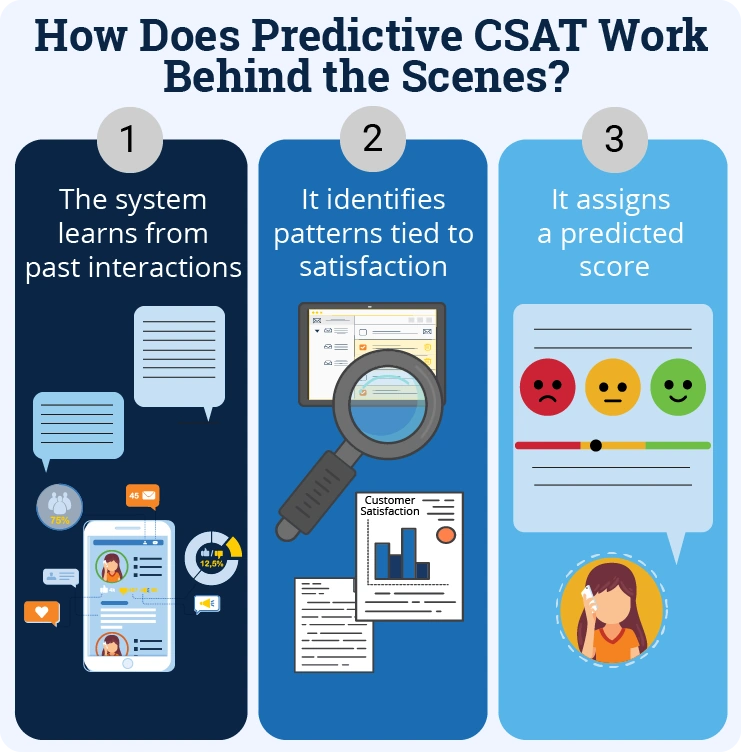
1. The system learns from past interactions.
It analyzes QA results, Auto QA insights, customer satisfaction outcomes, soft-skill behaviors, and how the issue was handled. This creates a blueprint of what strong and weak experiences look like across thousands of interactions—far more than a traditional QA team could manually review. The more complete the data, the better the predictions.
2. It identifies patterns tied to satisfaction.
Customers who feel confident often show consistent patterns, shorter pauses, more direct responses, and clearer confirmation of next steps. Meanwhile, customers who remain unsure may repeat questions, ask for reassurance, or speak more slowly.
Predictive CSAT identifies these cues at scale, spotting emotional shifts that could impact the customer experience.
3. It assigns a predicted score.
This can happen during or immediately after the interaction—long before surveys arrive.
Leaders don’t need technical expertise to use these insights. Predictive CSAT simply highlights interactions most likely to need attention, helping teams prioritize their follow-up efforts more effectively.
What Are the Four Biggest Competitive Advantages of Predictive CSAT?
Predictive CSAT gives contact centers visibility they’ve never had before, and SQM research shows that this insight helps leaders improve quality, strengthen coaching, and address issues sooner. Here are the most valuable benefits.
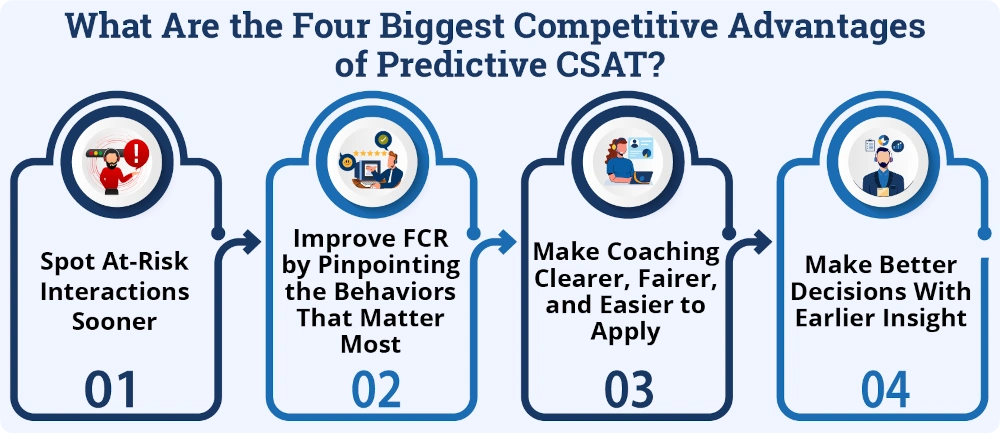

1. Spot At-Risk Interactions Sooner
Customers don’t always openly express dissatisfaction. They may sound polite or thankful while still unsure about the outcome.
Predictive CSAT flags interactions where the customer may still feel uneasy, such as:
- A billing explanation missing a final confirmation
- A technical issue resolved too quickly
- A policy explanation that created confusion
- A product activation that left the customer uncertain
- A service update that didn’t build confidence
These small signs of discomfort often reveal that the customer still needs clarity or reassurance. By catching these early, leaders can intervene before confusion leads to friction, frustration, or additional customer effort.

2. Improve FCR by Pinpointing the Behaviors That Matter Most
It’s challenging for leaders to know which agent behaviors influence satisfaction the most. Predictive CSAT brings them into focus.
Helpful behaviors include:
- Confirming understanding
- Reducing unnecessary steps
- Checking in during troubleshooting
- Explaining policies more clearly
- Showing empathy, especially in emotional situations
Instead of coaching agents broadly, leaders can guide them toward the specific behaviors that consistently improve resolution, confidence, and clarity. This targeted approach not only strengthens FCR but also reduces customer effort by eliminating confusion that might otherwise lead to future calls.

3. Make Coaching Clearer, Fairer, and Easier to Apply
Predictive CSAT supports more effective coaching by drawing insight from every interaction—not just a few evaluated calls.
It benefits both agents and leaders:
- Agents get clearer visibility into what matters most.
- Leaders can coach earlier and more specifically.
- Feedback feels fairer because it’s based on broader patterns.
If predictive data shows customers often sound uncertain after a particular type of explanation, the leader can coach the agent on slowing down, giving more context, or checking in more often aligned with real customer reactions, not assumptions.

4. Make Better Decisions With Earlier Insight
Predictive CSAT helps leaders see trends sooner, making decisions more informed and strategic.
It reveals:
- Call types that create confusion
- Policies customers struggle with
- Digital or self-service steps causing friction
- Training opportunities with the biggest impact
- Sentiment shifts before survey results confirm them
This early visibility allows organizations to adjust processes, update scripts, or redesign customer journeys before dissatisfaction spreads more widely. Predictive CSAT becomes a guide for where to prioritize improvements, ensuring that resources are invested in changes that matter most to customers.
Predictive CSAT in Action: What Are Leading Contact Centers Doing Differently?
Many contact centers are already using Predictive CSAT in practical ways:
1. Routing at-risk interactions to experienced agents
If confidence drops, calls can shift to a senior agent.
2. Following up proactively
Teams reach out earlier instead of waiting for low survey scores.
3. Prioritizing coaching where it matters most
Predicted sentiment helps leaders pinpoint coaching opportunities.
4. Testing changes faster
If predicted satisfaction rises after a script change, leaders gain early validation.
5. Combining insights with Auto QA
These approaches help contact centers move from reactive to proactive—fixing issues before they become complaints and strengthening customer trust by closing gaps quickly.
Why Does Predictive CSAT Work Even Better With Auto QA?
Auto QA and Predictive CSAT complement each other naturally
|
Auto QA Provides |
Predictive CSAT Adds |
Together They Show |
|
Full interaction coverage |
Likely customer sentiment |
What happened |
|
Consistent evaluations |
Emotional and behavioral cues |
How well it was handled |
|
Behavior-level insight |
Risk indicators |
How the customer likely feels |
|
Faster QA cycles |
Early alerts |
What needs improvement next |
This all-in-one perspective helps leaders act more confidently. Instead of relying on isolated results or incomplete feedback, they gain a comprehensive view that blends objective scoring with predicted emotion—giving them a deeper understanding of the customer experience.
What Should Leaders Look for in a Predictive CSAT Tool?

When evaluating Predictive CSAT solutions, leaders should ask:
- Is it built on real contact center data?
- Does it integrate with QA, Auto QA, and coaching tools?
- Does it explain which behaviors influenced the prediction?
- Is it simple to understand and trust?
- Does it support all channels?
A strong Predictive CSAT tool should be clear, practical, and easy to use. It should bring value to frontline leaders, supervisors, coaches, and executives—not overwhelm them with more dashboards. The best tools integrate insights directly into existing workflows, making predictive data part of everyday decision-making.
Prediction Isn’t the Future of CX—It’s the Present
Predictive CSAT is no longer a “future tool.” It’s something contact centers can benefit from today. It gives leaders early insight into customer sentiment, helps agents understand what matters most, and supports stronger, more consistent service.
When paired with Auto QA, Predictive CSAT delivers a clearer picture of customer experience and helps teams make improvements before small issues turn into larger problems. The result is a more confident, proactive approach to delivering great service across every channel.